
EPIRB: Your Last Line of Defense
An EPIRB (Emergency Position Indicating Radio Beacon) is life-saving equipment that, once activated, transmits your exact position to rescue coordination centers via the COSPAS-SARSAT satellite system. It’s the equipment that saves lives when everything else has failed.
The principle is simple: you trigger the beacon, the 406 MHz signal is picked up by satellite, your position is transmitted to the MRCC (Maritime Rescue Coordination Centre), and rescue services are dispatched. The delay between activation and signal reception is 1 to 3 hours in geostationary mode, nearly instant with a GPS-integrated model.
⚓ Expert Tip: The best equipment is what you know how to use. Fancy gear you never practice with is worse than simple gear you can operate blindfolded.
Registration: Mandatory and Essential
An unregistered EPIRB is almost useless. Registration links your beacon to your identity, your boat, your emergency contacts, and your navigation plan. Without registration, rescue services receive an anonymous distress signal without knowing who to look for or where to direct them.
In France, register your EPIRB on the CNSP website (Centre National de Surveillance et de Sauvetage Maritime) or via the online beacon registry application. Registration is free and takes 15 minutes. Update your information each time you change boats or navigation areas.
Activation: When and How
When to activate: only in case of real and immediate distress. Unjustified activation of an EPIRB is a criminal offense. Legitimate situations include: sinking, fire on board, man overboard, engine failure in heavy seas with imminent danger, and serious injury requiring evacuation.
How to activate: Remove the beacon from its mount, deploy the antenna, press the activation button for 3-5 seconds (some models activate automatically on contact with water). Keep the beacon exposed with the antenna vertical. The flashing light confirms transmission.
Frequently Asked Questions
EPIRB or PLB (Personal Locator Beacon)?
An EPIRB is attached to the boat, floats, activates automatically, and transmits for a minimum of 48 hours. A PLB is personal, smaller, activates manually, and transmits for 24 hours. On a boat, the EPIRB is the primary choice. A PLB is a supplement for trips in a dinghy or on foot.
Should I get a model with built-in GPS?
Yes, absolutely. Models without GPS must be located by satellite triangulation (delay 1-3 hours, accuracy 5 km). GPS models transmit the exact position within a few minutes (accuracy 100 m). The price difference (50-100 €) is well worth it.
How much does an EPIRB cost?
400-800 € for a quality GPS model (McMurdo FastFind, Ocean Signal RescueME, ACR GlobalFix). Budget 50-80 € every 5-6 years for battery replacement. It’s a marginal cost compared to a rescue — or the absence of one.
EPIRBs (Emergency Position Indicating Radio Beacons) are critical safety devices that can save lives in an emergency. This guide explains how to properly register, activate, and maintain your EPIRB to ensure help arrives quickly when needed.
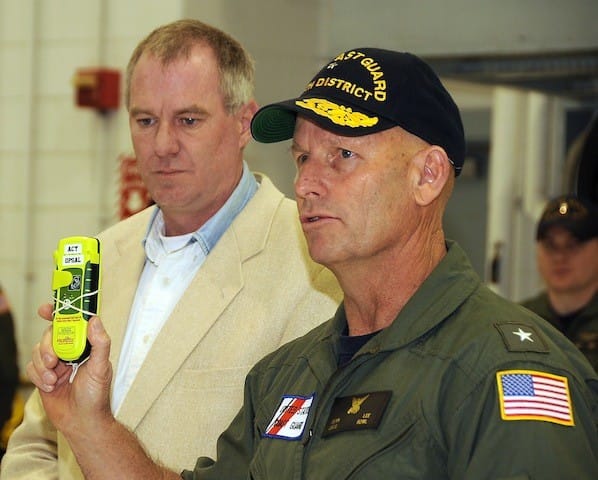
U.S. Coast Guard photo: An EPIRB is a critical safety device for any offshore vessel
What is an EPIRB?
An EPIRB is a satellite-linked distress beacon that, when activated, transmits a unique identifier and location to rescue coordination centers worldwide via the COSPAS-SARSAT system. Modern EPIRBs are waterproof, buoyant, and can operate for days on battery power. They are required equipment for many offshore vessels and are strongly recommended for any sailor venturing beyond visual range of shore.
Why Registration Matters
Registration links your EPIRB’s unique ID (hex code) to your vessel details, emergency contacts, and home port. This allows rescuers to:
- Identify the boat and owner quickly
- Contact family or crew emergency contacts
- Know the vessel’s description, floats, and typical sailing area
- Cancel false alerts faster
Unregistered EPIRBs may delay rescue or lead to false alarm penalties. Registration is free and typically valid for the life of the beacon (or until you update details).
How to Register Your EPIRB
In most countries, you register with the national Maritime Rescue Coordination Centre (MRCC) or equivalent. For US‑flagged vessels, NOAA handles registration. Europeans can often register through their national authority or via the COSPAS‑SARSAT portal.
- Locate your EPIRB’s ID: A 15‑digit hexadecimal code (e.g., `ABC123456789DEF`) printed on the label.
- Gather vessel information: Boat name, call sign, MMSI, size, color, home port, owner/operator contact details, emergency contacts (name, phone, relationship).
- Choose registration method:
- Online: Many countries offer online portals (e.g., NOAA’s site for US).
- Paper form: Downloadable PDF to mail or fax.
- Phone: Some MRCCs accept registration by phone.
- Submit and keep proof: You’ll receive a registration certificate or email confirmation. Keep a copy on board and in your personal records.
- Update when needed: Change of owner, vessel name, or emergency contacts must be updated promptly.
Activation: When and How
EPIRBs have two modes: manual activation (you press the button) and automatic activation (some models detect immersion or water ingress). In a life‑threatening emergency (man overboard, sinking, fire), you should activate the EPIRB immediately.
Manual activation steps
- Remove the EPIRB from its bracket (often requires lifting a cover or breaking a seal).
- Extend the antenna (if retractable).
- Press and hold the activation button until you see or hear a confirmation (usually a flashing light or beeping).
- Place the EPIRB in a secure, elevated location on the boat (or in a life raft if abandoning ship).
- Do NOT turn it off until rescued or instructed by authorities.
Note: Some EPIRBs also have a test function – use it according to the manual (usually once per month, for a few seconds only) to check battery and circuitry. Never activate the full distress signal during testing; use the self‑test mode only.
Battery replacement and maintenance
EPIRB batteries typically last 5–10 years depending on model and usage. After any activation, the battery must be replaced or serviced immediately.
- Check expiration date on the label.
- Replace batteries at an authorized service center (many EPIRBs are sealed units; entire device is replaced).
- Inspect the unit annually: clear the lens, check the antenna, verify the mounting bracket is secure.
- Keep a log of maintenance actions on board.
Common mistakes to avoid
- Not registering: You may face fines and rescue agencies may be slower to respond.
- Failing to update registration: If you sell the boat, transfer registration; if contacts change, update them.
- Testing the full distress signal: This can trigger a real emergency response and is illegal in many jurisdictions.
- Mounting in an inaccessible location: Ensure you can grab the EPIRB quickly in an emergency, and that it’s not locked away.
- Ignoring battery expiry: A dead EPIRB is useless; mark calendar reminders.
EPIRB vs. PLB vs. AIS‑SART
An EPIRB is vessel‑specific and designed for maritime distress. A PLB (Personal Locator Beacon) is for individual use and can be used on land or water. An AIS‑SART transmits a digital distress signal that shows up on nearby AIS receivers (good for man overboard near other boats). For offshore sailing, an EPIRB is essential; a PLB is a useful backup for crew.
Shop These Products on Amazon
→ Shop Personal Locator Beacon on Amazon
→ Shop Marine Emergency Beacon on Amazon
→ Shop Marine First Aid Kit on Amazon
⛵ Compare Yacht Specifications
Researching sailing gear? Check out detailed specs for these popular yachts:
Conclusion
Proper EPIRB registration and activation are not just legal requirements – they are a core part of your offshore safety plan. Take 15 minutes today to verify your EPIRB is registered, the battery is in date, and you and your crew know how to use it. In an emergency, that small preparation can mean the difference between a swift rescue and a tragedy.
Keep this guide handy, and review it annually.
