
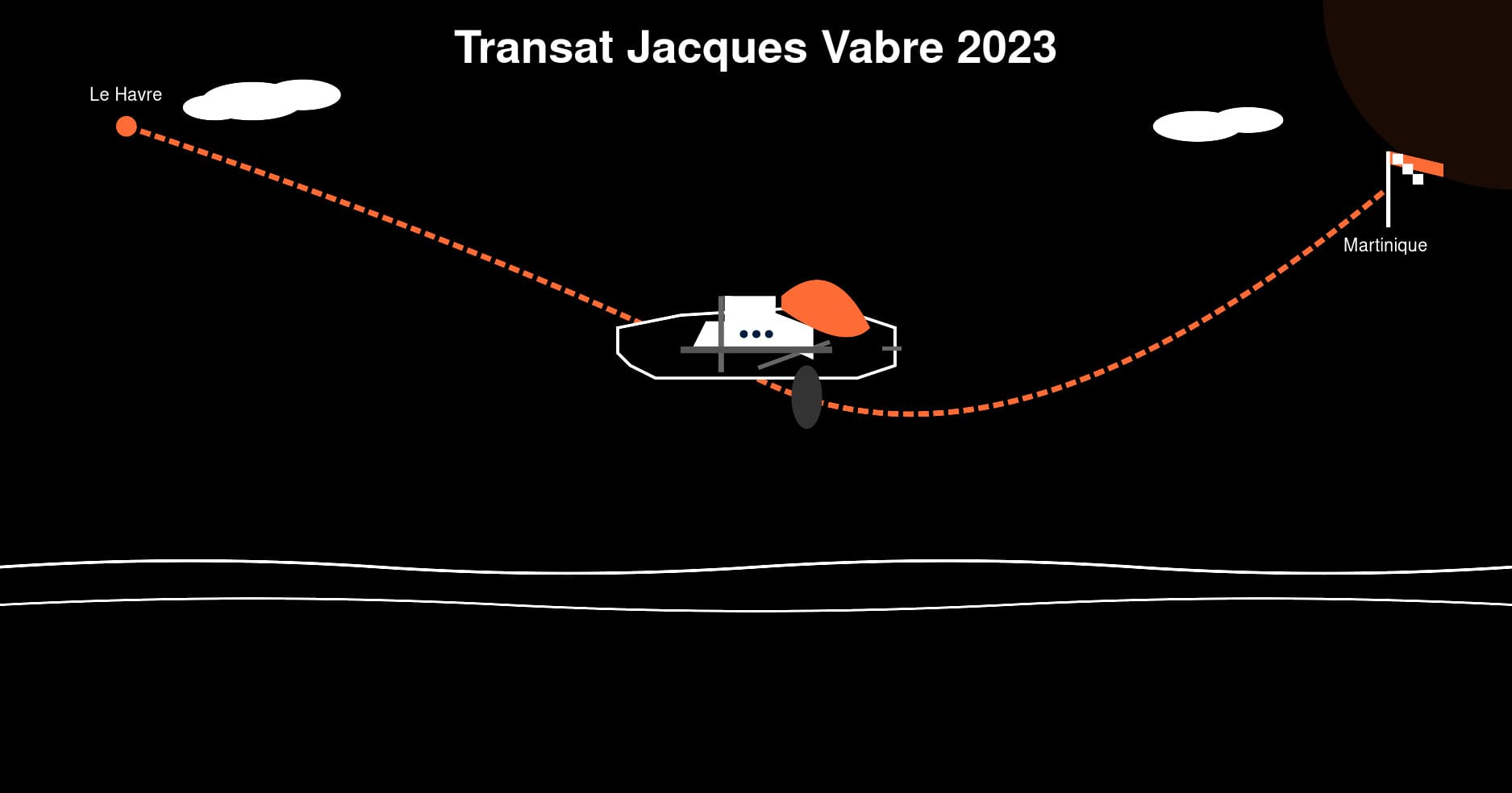
The Transat Jacques Vabre stands as one of offshore sailing’s most demanding and historic double-handed transatlantic races. The 2023 edition marked a significant milestone: 30 years since the race’s inception in 1993[4]. That year, the fleet once again departed from the iconic port of Le Havre, France[1], bound for the Caribbean, following the legendary coffee trade routes that gave the event its nickname, “La Route du Café.”
This article examines the 2023 race in detail: its challenging course, the remarkable diversity of boats and sailors, the start festivities in Le Havre, the performance of each class, and the finish in Martinique. We also explore the race’s economic and cultural impact, and what made this edition particularly memorable.
The Route: Following the Historic Coffee Trade
The Transat Jacques Vabre recreates the centuries-old maritime commerce between France and the Americas. Unlike solo circumnavigations, this is a pure point‑to‑point transatlantic dash. The course is not a simple great circle; sailors must navigate the North Atlantic’s shifting weather systems, contend with the doldrums near the equator, and often pass near island waypoints such as the Brazilian archipelago of Trindade e Martim Vaz.
The total distance varies by class. The fastest Ultim trimarans can cover nearly 7,500 nautical miles on their optimal rhumbline, while the slower Class40 monohulls sail closer to 4,000 nautical miles. All routes cross the equator twice, exposing crews to light winds, intense heat, and sudden squalls. The finish is always in a Caribbean port that has historical ties to the coffee trade—most recently Martinique, which became the permanent destination in 2021[5] after earlier finishes in Brazil and Costa Rica.
The 2023 fleet departed on October 29[1], with the start sequence spread across several classes to accommodate the record numbers[2]. The ultramarines went first, followed by Ocean Fifty, IMOCA, and finally Class40. This staggered start reduced traffic on the line but created its own tactical challenges: later classes had to judge whether to chase or avoid the earlier starters’ wind holes.
⚓ Expert Tip: Practice man overboard drills at least once per season. In an actual emergency, muscle memory matters more than theory.
The Classes: Four Divisions, Four Different Races
The Transat Jacques Vabre is unique in bringing together four distinct offshore classes, each with its own record books and strategies. In 2023, these teams and classes made up a record fleet[2]:
- Ultim – These are the giants of the ocean: 32‑meter maxi‑trimarans with towering rigs and hydrofoils. They can sustain speeds above 30 knots and peak over 40 knots. The Ultim class is the fastest, with winning times around two weeks. The 2023 winners, Armel Le Cléac’h and Sébastien Josse on Banque Populaire XI, finished in 14 days and 10 hours[3]—a staggering pace across the Atlantic.
- Ocean Fifty – Formerly known as the Multi50, these 15‑meter trimarans offer high performance with a more manageable crew size. The class has a limit of 10 boats to keep costs sustainable. In 2023, eight Ocean Fifty starters competed, including several veteran boats with proven offshore pedigree.
- IMOCA – The 60‑foot monohulls designed for solo ocean racing. They are the machines of the Vendée Globe, and the Transat Jacques Vabre provides rare two‑handed competition in these demanding boats. The 2023 fleet featured a record 40 IMOCA starters[2], representing nearly every team preparing for the 2024 Vendée Globe. The density of talent in this class was exceptional.
- Class40 – Introduced in 2004, the Class40 has become the most popular shorthanded offshore class worldwide. These 12‑meter monohulls are designed for safety, affordability, and performance. In 2023, dozens of Class40s lined up, making it one of the largest single‑class transatlantic races. The class offers close racing where boat speed, navigation, and crew work are finely balanced.
Each class had its own prize and ranking, but all shared the same start and finish ports. The variety of boats meant spectators could compare wildly different designs on the same ocean, creating a multifaceted regatta that appeals to a broad audience.
Le Havre: The Historic Starting Port
Le Havre, Normandy’s largest city, has been synonymous with the Transat Jacques Vabre since the very first edition in 1993. The relationship is more than logistical; the city’s identity is intertwined with the race. Le Havre’s status as a UNESCO World Heritage site recognizes its reconstruction after World War II, but its role as the “Cité de la Mer” (City of the Sea) is celebrated every two years when the race village opens.
The start environment is electric. For ten days leading up to the departure, the basin Paul Vatine transforms into a maritime festival. The 2023 race village welcomed over 655,000 visitors between Le Havre and Martinique combined. Hundreds of thousands lined the quays to see the boats, meet sailors, and soak up the pre‑race atmosphere. The event has grown into major economic and promotional engine for the region, with the association reporting a budget of €5.5 million for that edition—a 35% increase from 2021.
Population-wise, Le Havre is a substantial port city with around 165,000 residents. Its harbor handles between 65 and 80 million tons of cargo annually, making it France’s largest container port. This maritime DNA makes it the perfect launchpad for a race that celebrates ocean sailing and trade heritage.
The actual start sequence is a study in controlled chaos. Boats jostle for position near the line set between the committee ship and a pin buoy. In a fleet of nearly 100 starters, getting clear air and avoiding collisions is as important as raw boat speed. In 2023, the staggered starts by class helped, but the IMOCA and Class40 lines were still intensely crowded. A good start means avoiding being locked into the fleet’s slower pockets or forced to circle back for an early penalty.
At Sea: Strategies and Records
Once underway, each class pursued its own optimal strategy. The Ultims, with their foiling capabilities, aimed to stay in the strongest wind systems and use their high average speeds to reach the trade winds quickly. Their crews took calculated risks, pushing the boats to their structural limits. The 2023 Ultim victory by Banque Populaire XI in under 15 days demonstrated how far these machines have advanced.
The IMOCA fleet faced a tactical puzzle. With 40 boats, the fleet quickly spread across the Atlantic. Teams that could position themselves in the right wind shifts early gained a lasting advantage. Many IMOCA skippers used this as a final preparation for the upcoming Vendée Globe, testing both boat and crew in a competitive setting. The double‑handed format also allowed them to practice watch‑keeping and sail handling with a partner.
The Class40 race was perhaps the most tightly contested. These production boats are more evenly matched than the custom foiling Ultims, so small decisions on sail selection, routing, and crew coordination made the difference. In 2019, the Class40 winner finished in 17 days, 16 hours, 21 minutes—a time that stood as a reference for 2023 planning. That year’s winner, Ian Lipinski and Adrien Hardy on Crédit Mutuel, showed what a well‑prepared scow‑hull design could achieve.
Ocean Fifty trimarans occupy an interesting middle ground: faster than IMOCAs but less complex than Ultims. Their limited class size (capped at 10 boats) keeps the competition close and costs manageable. In 2023, eight starters produced a competitive fleet where reliability and steady speed were rewarded.
Weather is the ultimate adversary. The North Atlantic in October and November offers powerful westerlies near the start, then transition zones where teams hunt for the trade winds. The doldrums remain a hazard, with calms and thunderstorms that can erase a lead in hours. The best results come from teams that balance aggression with patience, pushing hard when conditions allow but conserving the boat and crew for the long haul.
Martinique: The Caribbean Finish
After two weeks or more at sea, the sight of Martinique’s volcanic peaks is a reward for weary sailors. The finish in Fort-de-France has become a tradition since 2021, but it’s a relatively recent development in the race’s geography. Martinique, as a French overseas department, offers a warm welcome and a festive atmosphere for the arriving crews.
Prior to 2021, the race finished in various ports that reflected the coffee trade’s history: Salvador de Bahia, Brazil (used several times between 2001 and 2017), Puerto Limón, Costa Rica (2009, 2011), and Itajaí, Brazil (2013, 2015). The move to Martinique brought the finish closer to the race’s French origins and created a more consistent logistical setup for organizers and teams alike.
In Martinique, the sailors are greeted by friends, family, and fans. The post‑race celebrations are legendary, but for many, the first priority is a long shower, a hearty meal, and a few hours of uninterrupted sleep. The finish line is set in the sheltered harbor, allowing yachts to anchor safely and crews to step ashore to a reception.
The race’s finish coincides with the Caribbean tourist season, boosting local engagement. The event’s “Coffee Route” theme is particularly meaningful in Martinique, where coffee cultivation has deep historical roots. The race reinforces cultural ties between Normandy and the Antilles, turning a sporting contest into a transatlantic dialogue.
Impact and Legacy
The Transat Jacques Vabre is more than a race; it’s an economic and promotional engine for the region. The 2023 edition generated a €5.5 million budget for the organizing association, a significant increase funded through sponsorships, municipal support, and visitor spending. Over half a million people participated in the race villages either in Le Havre or Martinique, creating a festival atmosphere that lasts weeks.
For the sailors, the event offers a rare chance to compete in a double‑handed transatlantic race with full media coverage. It serves as a proving ground for newer sailors looking to move into solo offshore racing, and as a tune‑up for Vendée Globe contenders. Many past winners have gone on to success in solo circumnavigations, making the Transat Jacques Vabre a key step in a sailor’s career.
The race also pushes technological development. The competition among Ultim builders drives foil design and carbon engineering. The Class40’s strict one‑design philosophy keeps costs in check while still allowing incremental improvements. The IMOCA field represents the cutting edge of solo racer development, with teams using the two‑handed race to test new hull shapes and rigging configurations under load.
Culturally, the race celebrates France’s maritime heritage. The coffee trade link reminds participants and spectators that oceans have always connected people, cultures, and economies. The name “Jacques Vabre” honors a 19th‑century coffee merchant who established trade between Le Havre and Brazil—a reminder that the race continues a commercial legacy.
Looking Ahead
With its 30‑year anniversary, the 2023 Transat Jacques Vabre proved the event’s enduring appeal. The record fleet, impressive performances, and festive atmosphere demonstrated that double‑handed transatlantic racing is thriving. The challenges facing ocean sailing—climate change, cost pressures, safety concerns—were balanced by the sport’s resilience and the sailors’ passion.
The next edition will again start from Le Havre and finish in Martinique, continuing the Coffee Route tradition. Teams are already analyzing boat performance data from 2023 to gain an edge. The Ultim class continues to evolve, with foils and control systems being refined. The IMOCA fleet is approaching the 2024 Vendée Globe with many teams using Transat experience as a benchmark. Class40 builders are preparing new models for the next generation.
For fans, the Transat Jacques Vabre offers accessible drama: two‑person teams battling the elements, pushing their boats to the limit, and racing toward a Caribbean finish. It’s a story that combines human endeavor, technological innovation, and historical continuity—a true celebration of offshore sailing at its best.
Shop These Products on Amazon
→ Shop Offshore Sailing Jackets on Amazon
→ Shop Satellite Communicators on Amazon
⛵ Compare Yacht Specifications
Researching sailing gear? Check out detailed specs for these popular yachts:
Sources
- BoatsNews: Start of the Transat Jacques Vabre 2023 in Le Havre, follow the start live – Confirms start date and location.
- OceanTracking: Transat Jacques Vabre – 95 boats in the Ultim – Imoca – Ocean Fifty – Class40 categories – Reports fleet numbers by class, including 40 IMOCAs.
- la1ere.franceinfo.fr: Ultim victory after 14 days 10 hours – Provides winning time for the Ultim class.
- Transat Jacques Vabre: Official Race Site – Establishes Le Havre as start city from the beginning.
- Martinique Tourisme: Finish location history – Documents the evolution of finish ports, confirming Martinique from 2021 onward.
